
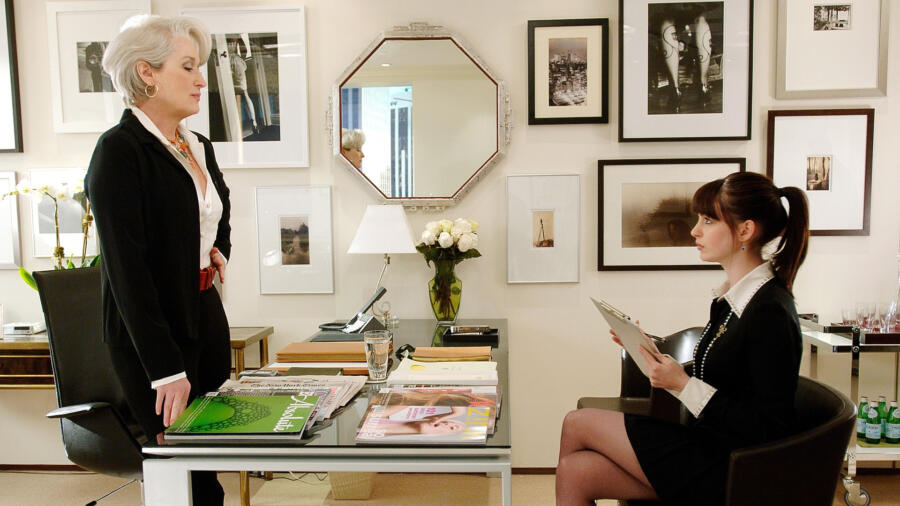
Re-watching “The Devil Wears Prada” recently, I had to go back and check its release date. I’d seen the movie before, of course, many times including in the theater, but this time something seemed off. What year did this film come out again?
Answer: 2006.
After a certain age, as some of you may already have discovered, time really does fly. But a decade is a decade, and much to my surprise, “The Devil Wears Prada” turns out to be one of those films that stands as a marker of how much our attitudes have changed during a reasonably short period of time.
In fact, watching it now made me feel like I’d been dropped into a strange opposite world: had there ever been a time when Miranda Priestly was considered a villain, and not simply a wonderfully flawed woman at the height of her power? When Andy Sachs could be thought of as anything but as a silly, spoiled, entitled young woman? When the business of fashion was viewed as entirely supercilious? Apparently, yes.
But wait, let’s consider for a moment where we were, culturally speaking, in 2006. Beyoncé had not yet put a ring on it. Taylor Swift was still an up-and-coming country girl. Facebook would only become available to the public for the first time in September. And Instagram? Incredibly, people were still taking photos on film. Filters remained something most people used for their coffee.
When “The Devil Wears Prada” was released in June 2006, it was an immediate hit (early proof that there is money to be made by featuring women talking to each other on-screen about things other than relationships; commonly known as the Bechdel test). The film is based on Lauren Weisberger’s 2003 novel of the same name, and was positioned as “Sex and the City” meets “Funny Face” meets “Unzipped.” On the surface, anyway, it’s about a girl who comes to New York to be a “real” journalist and gets a job as the assistant to the city’s most powerful, and infamous, fashion magazine editor. Weisberger worked for a time as Anna Wintour’s assistant, and it has long been assumed that the character of Miranda Priestly (played to silver, streamlined perfection by Meryl Streep) was directly inspired by her experience with the real-life legendary Vogue editor.
By the time TDWP hit theatres, Wintour had been running Vogue for nearly two decades. She was a well-known figure in New York City, frequently dubbed “Nuclear Wintour” by the press for her icy exterior and demanding ways. To this day, rumors of her exacting demands, true or otherwise, greet wave-after-wave of college grads hoping to work in fashion like some sort of emergency alert: Don’t wear all black to the interview; she likes color! Don’t look at her directly in the elevator!
This kind of outsize gossip about powerful New Yorkers was (and is) not unusual; the urban legends that surround film producer Scott Rudin (“Zoolander,” “The Social Network”) are equally notorious. (I once knew an assistant who claimed he was barred from taking the subway, lest he ever be unreachable when Rudin needed him.) But there was a special mystique connected to Wintour, largely, one imagines, because she never publicly responded to the criticism. (She did however, arrive at the premiere of TDWP dressed in, yes, Prada. Oh the memes, that could have been.)
As it turns out, far from condemning Wintour to permanent villain status, “The Devil Wears Prada” merely heralded the beginning of a continued fascination with her; three years later “The September Issue” would be released, sparking an entirely new, and now real-life obsession, with the machinations of team Anna, which continue to this day.
Perhaps more importantly, TDWP, in the form of Streep’s show-stealing Priestly, signaled the return of the powerful complicated woman to our cultural vocabulary. (It’s not a coincidence that Wintour’s famous predecessor, the singular Diana Vreeland—on whom “Funny Face’s” Maggie Prescott was based, incidentally—also enjoyed a resurgence of popularity in the aftermath of “The September Issue.”)
To be sure, Hollywood had not staked out new ground with Miranda Priestly and her domineering disposition; its so-called Golden Age is practically riddled with complicated powerful women. Think Bette Davis in “All About Eve” (and then consider how much more dishy TDWP might have been if Andy had been gunning for Miranda’s job, instead of running from it). Think of Katharine Hepburn in…actually, everything Katharine Hepburn did falls under the description of powerful and complicated. Take the career of Joan Crawford or Barbara Stanwyck. The history of Hollywood belongs to these thorny, commanding, magnificent creatures just as much as it did to Humphrey Bogart’s anti-heroes, Cary Grant’s suaveness, and John Wayne’s testosterone.
Or at least, some of its history does. For a few decades, they appeared to fall out of favor and sort of faded away, squeezed out, it seems, by the same corseted thinking about the roles of women that brought us Marilyn Monroe’s cleavage. When they did pop up again, they were largely lacking in shades of grey. Patricia Neal’s 2E in “Breakfast at Tiffany’s” (not to be found in Capote’s novel) is craven in her desire to keep Paul Varjak as her personal, er, I think the phrase is sex toy. Mrs. Robinson is predatory. Sigourney Weaver’s Kathleen Parker, in the sublime “Working Girl,” is a composite of all the worst, most comic, attributes we ascribe powerful women: selfish, dishonest, I’ll just say it, catty.
Enter: Miranda Priestly.
It is largely thanks to Meryl Streep’s demands that the Priestly was not a one-dimensional cartoon; Streep, for instance, came up with the now-iconic “cerulean” monologue, and insisted it be kept in its entirety. This is perhaps not surprising considering Streep, herself, was 55 at the time (and, by the by, had racked up more Academy Award nominations than any other actor in history, including Katharine Hepburn who, ahem comes in a distant second tied with Jack Nicholson); one imagines she was eager to portray someone on the screen that reflected, at least somewhat accurately, the demands on a powerful woman in real life. She said as much in an interview marking the tenth anniversary of the film: “The most interesting piece to me was the responsibility lying on the shoulders of a woman who was the head of a global brand and fashion empire.”
The result is that we get an unexpected heroine, whom, despite her faults, we find ourselves unexpectedly siding with in the end. When, following their final confrontation, Andy rejects Miranda’s claim that “everybody wants to be us” and walks away, both from the limo they are in and her job, I found myself shaking my head, get back in that limo, you idiot.
How much of this reaction is the result of our current culture and how much of this is my own maturity? I’m not sure. In the last decade, social media has punched holes through many established social norms and prejudices; not least being the automatic assumption age makes women irrelevant, and power makes them less human…one might even use the word nasty, here.
However, I am also older and further along in my career, and Miranda has morphed into a person to emulate, not scorn. As a friend said to me the other day when I mentioned how surprising I now found the film, “of course, we all want to be Miranda.”
Interestingly, it was Streep who changed the final line from “everyone wants to be me” to “everyone wants to be us.” A decade later, I’d argue, many of us are ready for it to be changed back.